Publishing MediaCentral Assets to the Web
You can also publish your package to a Web site without using an iNEWS story by selecting video from Interplay Production or Interplay MAM, adding and modifying the text for the story, and submitting the package for approval.

If your MediaCentral configuration does not include iNEWS, the iNEWS options included in Media Distribute are disabled.
If you have configured a WorldNow CMS profile, you can use the Standalone Video layout to specify a number of WorldNow categories for your media package. For more information, see
Publishing MediaCentral Assets to a WorldNow CMS.
To prepare a video for publishing to the Web:
1. Click the Layout selector and select Media Distribute.
The Media Distribute layout opens.
2. Do the following to load an asset in the Media pane.
a. Double-click an Interplay Production server in the Launch pane.
The folder hierarchy of the MediaCentral database displays in the Assets pane.
b. Navigate to a sequence in the Asset pane, and then double-click the asset or drag it to the Media viewer.
For information on opening media in the Asset pane, see “Navigating the Interplay | Production Database” in the Avid MediaCentral | UX User’s Guide.
The asset opens in the Media pane.
c. If you do not want to add the entire video to your package, set In and Out points in the Media pane and create a subclip and then load the subclip in the Media viewer.
3. Click the Panes Menu button and select Web Story.
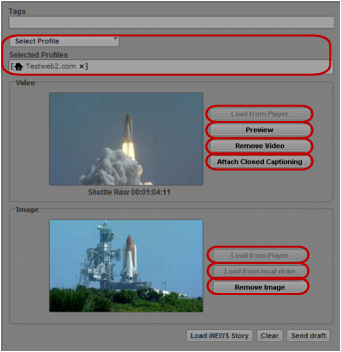
The Web Story pane opens. The options available depend on which Web CMS settings your MediaCentral administrator has configured.
Web Story pane: Selected Profiles; Load/Remove Video buttons; Preview button, Attach/Remove Closed Captioning button; Load/Remove Image buttons; Load from local drive button
4. Click Load from Player.
The video displays in the Video or Image area of the Web Story pane. The position indicator in the Media viewer determines the video poster frame that appears on your Web page.
5. (Optional) If you want to use a separate image to display in the Video area as the poster frame for you video, load a new video in the Media viewer and then click Load from Player. This allows you to use a poster frame that does not appear in the video for your package. You can also use a separate image from your local system by clicking Load from local drive.
6. (Optional) Add, delete, or modify text in the text boxes for the story title or headline and any other text boxes. The fields requiring text depend on your Web CMS configuration.
Some text boxes — for example, the Body or Story Body text box — include a rich text editor that allows you to edit your content and to format text to match the styles used on your Web site. You can also use the Source button to view the HTML markup for your story.
7. If necessary, add or update any metadata to the Web Story fields that require information, depending on your Web CMS configuration — for example, associated links or alternative text for graphics.
8. If your CMS supports video profiles, click the Video Profiles menu, and select a profile. You can select multiple profiles for each target.
Profiles display in the Selected Profiles area.
| System profile |
| System profile with video transcoding |
| User profile |
If you want to delete a profile, click the “x” next to the profile name.
9. If your CMS supports additional graphics content — for example, branding, header, or Story Body graphics — you can move the position indicator in the Media viewer and then add the new image to the appropriate field in the Web Story pane.
10. If your CMS supports closed captioning and if your video includes closed captioning information, click the Attach Closed Captioning button.
Closed captioning information is added to the media package, and the Attach Closed Captioning button changes to the Remove Closed Captioning button. You can remove closed captioning from your package by clicking Remove Closed Captioning.
11. Click Send draft.
The story is sent for approval and the Web Story pane clears all fields. For information on approving stories for publishing, see
Review and Approval.